Disgraced members of The Reverse Order of Canada List
From 2008 to 2013, Prime Minister Mark Carney was Governor of the Bank of Canada. As such, he was very aware of the CPP’s surplus, which is approaching $500 billion in 2026. Because:
half of Canadians are now near bankruptcy,
the CPP’s surplus and potential could help solve that problem,
when Premier Smith demanded Alberta’s share of the fund, he erected roadblocks,
he is the only Canadian who could force the CBC to not cover the CPP’s sruplus,
he is the head-of-the-snake who could probably propose and obtain CPP reform tomorrow, thanks to his majority in parliament,
he has been placed at the very top of the list.
Conservative Party leader. Pierre Poilievre, emailed me the following in 2020 regarding the potential of the CPP’s surplus.
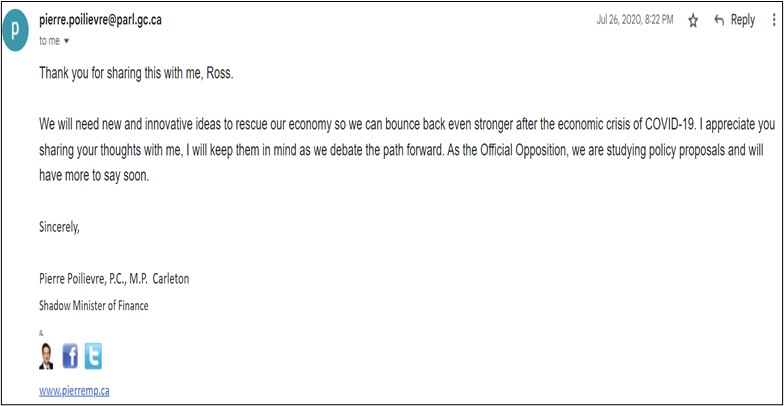
Even back in 2020, he was very aware of the CPP’s surplus and potential. Yet, even though his lacklustre party for the last ten years probably could have won a majority if his platform included CPP reform, he has never mentioned the CPP’s surplus. The power and influence of the financial industry must be enormous. Mr. Poilievre sits just below Mark Carney on The List.
Because CPP reform could immensely help Canada’s less fortunate, the left-wing NDP party is the logical party to advocate for CPP reform and even win a majority if the other two parties refused to join them. Yet, despite repeated pleas from me for CPP justice, the party has remained absolutely silent on this possibility of providing Canadians with arguably 100 times the relief of any recent policy of any politician. Avi Lewis, the current NDP leader belongs third on The List.
Following is a list of all MPs who have abandoned their mandate and remained silent regarding this solution to the woes of most Canadians.
Aboultaif, Ziad Conservative Edmonton Manning Alberta
Acan, Sima Liberal Oakville West Ontario
Aitchison, Scott Conservative Parry Sound—Muskoka Ontario
Al Soud, Fares Liberal Mississauga Centre Ontario
The remaining MPs will soon be placed here.
Is buying off politicians to favour the 1% and abuse the 99% happening in Canada, like the US?
Democracy Watchis a
“national non-profit, non-partisan organization, and Canada’s leading citizen group advocating democratic reform, government accountability and corporate responsibility”.
MENTION 47% VERSUS 25-30%
Their statement on political donations explains why politicians have not exploited the CPP’s surplus to gain, possibly, millions more votes.
“Politicians are supposed to be the referees who decide what is in the public interest…
…so why do we allow wealthy private interests to buy them off with huge donations, including secret donations, and why do we allow interest groups to spend secret, unlimited amounts of money before and during many election campaigns?”
Is it possible the financial industry made such “secret donations” to the three mainstream political parties with the conditions,
“You must not mention the CPP’s $257 billion surplus. You must not mention how a $2,000 per year contribution directly to CPP Investments could likely give a 25-year-old $1.5 million by age 65, with no extra cost.”
David Meslin is possibly Canada’s most prominent champion of democracy. His TED talk has had 1.7 million views and his Facebook video on how our voting system has failed us has over 2.5 million views. In his book, TEARDOWN Rebuilding Democracy from the Ground Up, he states
“Bribery is still a part of Canadian politics today, at all three levels of government… But stories of politicians or political staffers explicitly breaking rules for their own self-interest represent only the tip of an iceberg and are arguably a distraction from the bigger picture. The primary problem we’re facing isn’t criminal activity but rather the fact that excessive private influence has become a normal and legal part of our system.
To put it more bluntly, our political system has evolved into a sophisticated enabler of mass institutionalized bribery.”
By a process of elimination, the most likely industry engineering this cover-up is the financial industry. The actuarial industry earns roughly $600 million per year, just 0.6% of the financial industry’s estimated earnings. The actuarial industry contributes by denying a $257 billion CPP surplus. The media industry is highly unprofitable. They contribute by never publishing any stories about a $257 billion CPP surplus.
Only the financial industry has both the resources and the motivation to bribe politicians. For example, the industry earns an estimated $123 billion in fees per year. Why not secretly donate “just” $100 million, 0.08% of that $100 billion, to our three mainstream political parties? This would give $33 million to each of the parties.
Such a donation can be easily justified. For example, the industry may suspect voluntary contributions to the CPP could reduce their annual profits by 10%, from $123 billion to $111 billion. Spending just 0.08% of their profits, $100 million, now to preserve 123 times that, $10 billion annually, makes good (but not ethical) business sense, especially if these secret donations can never be traced back to the donor.
Do political parties need financial help? There have been two elections since Fall 2019. For each election, there are 330 ridings to fund, thousands of signs to pay for, hundreds of TV and newspaper ads to pay for, travel expenses for the leader and his entourage, political consultants to pay, polling companies to pay, nomination programs for many ridings, etc.
Moreover, the lucrative pay-per-vote subsidywas eliminated in 2015. It gave the three parties a total of $266 million between 2004 and 2015. However, with inflation and two federal elections in the last three years, the costs of running a political party have skyrocketed.
In terms of legal, documented donations, each political party only receives roughly $12 million, in a good year. Compare $12 million to the financial industry’s possible $33 million “secret” donation to each party.
The motivation for the financial industry is there – preserving a $100 billion revenue stream in exchange for a relatively trivial expenditure. And the evidence is there – political parties are refusing to discuss the CPP’s irrefutable $257 billion surplus, even though it could possibly bring them a majority win.
Civil servants, like our deceptive Chief Actuary, are encouraged by politicians to deceive the Canadian public. In a December 29, 2021, editorial, the Globe and Mail wrote
“A fundamental tenet of democratic governance is to be as open and transparent as possible. In Canada, only lip service is paid to this ideal…The deeper problem, and one that is more pernicious, is how government officials are operating, whether it is not allowing civil servants to speak with the press, or redacting reams of information that should not be redacted. It’s a culture across governments in Canada that erodes transparency in democracy. It needs a wholesale reset.”
We members of the CPP don’t have a chance. Firstly, it is likely all three parties have been bribed by the financial industry to never mention the CPP. Secondly, actuaries are denying the CPP’s surplus with preposterous arguments. Thirdly, it appears the entire Canadian press has a veto on publishing anything regarding the CPP’s surplus. Fourthly, civil servants are not allowed to speak frankly with the press.
This alleged cover-up is over ten times the size of the largest cover-up in Canadian history, the Charbonneau Commission, where Quebecers indirectly lost $15 billion because of bid-rigging. With the CPP, 17 million Canadians are directly losing $10,000 each.
Two political parties should be ashamed
The Liberals are hypocrites. Mr. Trudeau has pledged to help seniors “retire in dignity”. Ms. Freeland has written a book about how the system is rigged in favour of the “super-rich plutocrats”. Their financial advisor, Mark Carney, has also written a book that states our capitalist system is rigged to favour the wealthy. Yet, with an opportunity to help millions of Canadians, Canada’s sputtering economy, spiraling debt and income inequality, they have opted to be bought off by deep pockets.
And the Liberals are abusing the democratic process. On Dec. 9, 2021, the Editorial Board of the Globe and Mail wrote:
“It is not Mr. Trudeau’s place to choke off the debate and scrutiny that are the oxygen of our democracy, and the fact he continues to get away with doing so should worry all Canadians.”
As taxpayers, we Canadians pay the CBC roughly $1 billion per year to give us unbiased reporting on all newsworthy topics. In return, we reasonably expect the CBC to fill the void created by the private sector media’s veto on certain topics.
Instead, the CBC has failed us miserably. Despite receiving several submissions from me summarizing the CPP’s surplus and potential, our CBC has published absolutely nothing on a $257 billion CPP surplus. It is likely that the Liberal party, because they are in power, have vetoed any stories by the CBC on the CPP. This may be part of the informal agreement that was made when the Liberals received millions of dollars in secret donations, likely from the financial industry.
The NDP is allegedly the champion of the “little guy”. Their website boasts
“Making life more affordable for everyday people,
Building an economy that works better for more people,
Taking better care of each other,
The courage to do what’s right.”
This suggested CPP legislation addresses all these admirable statements yet they have done nothing. Moreover, most NDP left wing proposals do not become legislation because they increase the deficit. This CPP proposal would reduce the deficit by roughly $50 billion. The NDP Party might be even more hypocritical than the Liberal Party.
The April 2022 Liberal/NDP coalition is noteworthy. Why would the Liberals not take all the kudos for dental care and pharmacare by legislating it themselves, with no coalition? This coalition means the NDP will receive much of the credit for this needed assistance. Meanwhile, the Liberals may lose votes because a coalition for three years denies us democracy. Did the NDP say to the Liberals
“Give the NDP credit for initiating dental care and pharmacare or we will tell Canadians how you are ignoring the potential of the CPP.”
One can only surmise.
Could The Conservatives be Canada’s CPP saviour?
The Conservatives and the CPP have some history. Conservative Finance Minister Jim Flaherty, who passed on in 2014, is the only politician who saw and researched the potential of voluntary contributions to the CPP. And that was in 2011, when CPP Investments only had a 4% surplus and had not demonstrated its outstanding investment talent. Access to Information shows the financial community responded to Mr. Flaherty’s research with baseless arguments. Unfortunately, no Conservative politician has followed Mr. Flaherty’s admirable lead.
The Conservative Party traditionally tries to reduce the deficit and chastises the Liberal Party for overspending. This CPP proposal would gain them, possibly, millions more votes while reducing the deficit. They should be seizing the opportunity.
A $100 million donation to political parties may sound outlandish. However, Democracywatch.ca states
“Canada’s biggest corporations spend $25 billion annually on their lobbying and promotion efforts”.
Corporations spend 250 times $100 million every year to invoke favourable legislation or veto unfavourable legislation.
Lobbyists are highly paid, competent, convincing, educated experts who have delivered thousands of presentations to often naïve politicians. Lobbyists likely use any means available to steer legislation in the direction their clients want. If they fail, they will be out of a job. If they succeed, they will receive a considerable portion of that $25 billion, possibly annually.
The two graphs below show that, to the financial industry, $100 million is a mere 0.08% of their profits. Meanwhile, a $100 million illegal contribution to the three mainstream parties might quadruple the money available for election campaigns and other party expenses.
Do politicians also receive a portion of that $25 billion?
Like some salesmen, lobbyists will use any means available to achieve their goals, which are almost always a benefit for their client but a loss for the 99%.
Almost all lobbying has little impact on the income of 99% of Canadians. For example, a builder may lobby to get permission to build on land owned by a farmer. If he succeeds, it is a win/win/win. The farmer wins, the builder wins, and Canadians get more homes, likely at a lower price.
However, secret donations and lobbying regarding the CPP are now likely depriving 17 million Canadians of a deserved $170 billion and a chance for younger Canadians to have $1.7 million at age 65, at zero cost. This is an affront to democracy and a national disgrace.
In a true democracy, all Canadians should be allowed to lobby. And those lobbyists representing the most Canadians should be heard first. Your author, albeit informally, represents 20 million members of the CPP. Unlike most other lobbyists, he is unpaid. He has been instrumental in bringing $440 million more per year to low-income seniors. Seniors need a lobbyist because CARP, Canada’s most powerful lobbyist for seniors, has abandoned them regarding the CPP, probably for the sake of profit. (See CARP has abandoned seniors.)
Nevertheless, several times your author has requested a meeting with our Minister for Seniors. He did not even receive a response. Lobbying is a powerful force but not a level playing field. It immensely favours the rich.
If the above makes you doubt the trustworthiness of our politicians, you are not alone.
My MP in 2019, the principled Jane Philpott, watched a half hour presentation from me on the CPP, after she parted ways with the Liberals. She directed me to two poverty activists. Her final words to me were a disdainful “Disgraceful lobbyists”.
Some government cover-ups are excusable. For example, it may be a government is downplaying the side effects of the COVID vaccine. This is excusable because the net effect of this policy is less deaths overall.
This CPP cover-up is different. It appears that the financial industry is buying off politicians so that their industry can retain every penny of profit possible while depriving Canadians of a deserved $170 billion.
The invisible hand of capitalism - Beneficial or detrimental?
Adam Smith, the pioneer of political economy, stated that capitalism has a beneficial “invisible hand” which
“Through individual self-interest and freedom of production and consumption, the best interest of society, as a whole, are fulfilled.”
Half is true. The CPP shows there is an invisible hand in Canada’s current version of capitalism. However, it is not benevolent. It is malevolent and controlled by the 1%. It is subtly taking deserved wealth from the 99% and putting it in the hands of the 1%.
Canadians do not trust their politicians. A national CBC-commissioned survey in May 2019 finds 88% feel that politicians care more about staying in power than doing what’s right, and 78% say they believe that the country is divided between “ordinary people” and “elites.”
A national survey released in June 2017 found that only 10% of Canadians have a lot of trust in political parties.
A national survey released in November 2015found that: more than 60% of voters believe that Canadian politics is a corrupt game; 50% said that they would vote for a party that they didn’t really support if the politician or party they support acted unethically, and; 20% said that political corruption had led them to stop voting;
An October 2014 survey by the Gandalf Group for Ryerson University found only 13% of adult Canadians trust politicians (and only 9% trust lobbyists);
Wise words from a champion of democracy - Bob Rae
Bob Rae is one of Canada’s most respected politicians. In his book, “What’s Happened to POLITICS?”, he paints a depressing picture of our political system in Canada. Following are some quotes that encourage public participation in politics because remaining idle is a dangerous choice.
Preface – Page ix: “Politics is, above all else, a public pursuit. Its concerns and goals are not ends in themselves. They are important only if they help us to answer one question: How do we make individual Canadians’ lives better? There is an increasing sense that this has been last in today's world, and we urgently need to change that.”
Page 57 - “Evidence and measurement should be the guide of policy, not ideology or the self-interest of those who benefit from one way of doing things. There must be a willingness to assess the outcomes of programs in order to allow change to happen. There is a complacency and sense that nothing much can be done because of the power of impersonal forces [aka three selfish, powerful industries?]. This is the first thing to be overcome. The second is the notion that simply talking about the issue solves it. We need to be prepared to take steps, without throwing our understanding of the economy out the window. It's not an easy balance to strike, but we have no choice.”
Pages 63-64 - “If the political process, and the media fog that surrounds it, are not able to generate the decisions that are now needed more than ever, it will fall to an active citizenry, colleges and universities, nongovernmental organizations, and others to frame the debate and make change happen.”
The GIS story - proving politicians need monitoring
Recall the Guaranteed Income Supplement clawback rate. It was as high as 76% and reduced the income of low-income seniors by $440 million per year. The clawback rate was so buried in complex government tables that the CARP Vice-President of Advocacy, who is an accountant, had to contact me for an explanation. When she discovered it was true, she appealed to Mr. Morneau for a change, and he did.
If a full-fledged accountant cannot figure out the GIS tables, what chance does a low-income senior have?
Was this clawback rate an oversight? Did some clerk make a mistake? Or did Mr. Morneau, or his predecessor, say to his colleagues
“Make the GIS tables so complex that no low-income senior will be able to figure out that, for every $100 he earns, his cash income will only increase by $24. This way we can keep our GIS payments and our troubling deficit down.”
This GIS gouge shows that politicians will bury their unjust practices in complex financial data at the expense of millions of low-income Canadians.
If politicians engaged in a cover-up regarding the GIS, why not do it with the CPP? Success is likely because:
Actuarial science is complex. Data can easily be manipulated to produce misleading results.
Actuaries have much to lose if the CPP’s surplus is revealed. They will be aggressive with their part in the cover-up. They have been.
The powerful financial industry has much to lose if the CPP’s surplus is revealed.
The CPP has no Board of Governors, a pathetic peer review, and no audit by our Auditor General. The Chief Actuary has full rein and will continue to disgracefully deceive Canadians for years, to protect his at-risk industry.
The probability of some pesky activist with financial skills revealing this cover-up is very low. Even if he uncovers it, the complicit Canadian media will never write a word about the CPP’s surplus.
Three powerful industries have joined forces to conceal the CPP’s surplus and potential. Even if there is an investigation, politicians can deflect the blame by saying “Canada’s Chief Actuary told us there is no surplus. Because actuarial science is so complex, we must listen to him.”
These three industries are likely providing millions of dollars in secret donations to each political party to keep the news of the CPP’s surplus secret.
All political parties have agreed to never mention the CPP’s surplus. There is no danger any party will make CPP legislation part of their platform, even though such a platform could be worth millions of votes.
Likely for these reasons, politicians have joined three powerful industries in keeping the news of the CPP’s gigantic surplus suppressed.
In a true democracy, when 51% of the people vote in favour of certain legislation, that legislation is enacted.
However, when 1% of our country can manipulate the system at the $170 billion expense of the other 99%, Canada is very far from a true democracy.

