Politicians know democracy is often compromised…but they enable it instead of combat it.
Prime Minister Carney, in his book VALUE(S), describes Canadians as victims of:
"Twisted economics, an accompanying amoral culture, and degraded institutions whose lack of accountability and integrity accelerate the system’s dysfunction."
In her book, PLUTOCRATS, Finance Minister Chrystia Freeland highlights the prevalence of elite attempts to use political influence for personal gain, stating,
“In an age of super-wealth, we need to be constantly alerted to efforts by the elite to get rich by using their political muscle to increase their share of the pre-existing pie, rather than adding value to the economy and thus increasing the size of the pie overall.”
Pierre Poilievre asserts that "Our system is broken.” and “Fire the gatekeepers.", probably alluding to our complicit Chief Actuary and the complicit President of the CBC.
In 2020, Mr. Poilievre responded to my email with the above details, saying,
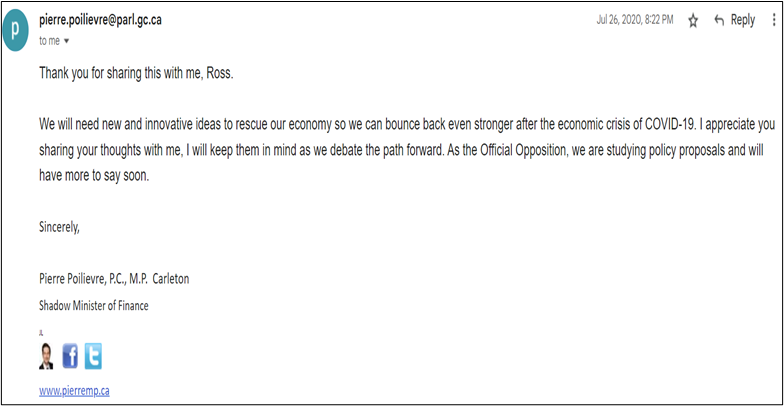
Three of Canada’s top politicians are very aware that, behind the scenes, democracy is losing out to wealthy interests. It is deeply troubling that they all ignore this opportunity to right the ship and bring huge benefits to 99% of Canadians.
It appears that all three parties have agreed to remain mute. On such a crucial issue, for ten years, why has the Conservative and NDP parties never mentioned the CPP’s surplus when it could help them overcome the Liberal government’s stranglehold? The tentacles of the financial industry must be enormous but, unlike the US, under-the-radar.
In early 2026, politicians witnessed a marked in increase in poverty, food bank usage, mortgage defaults, and insolvency. Politicians could have easily distributed a no-risk $10,000 CPP surplus distribution to 20 million Canadians to substantially counter the financial problems of a majority of Canadians. Then, however, Canadians would learn of the CPP’s potential to likely provide all young Canadians with a CPP pension of $100,000 CPP pension in 2026 dollars. And they would learn how voluntary contributions could give the investor as much as seven times the profit. And then the financial industry would lose billions, per year.
Instead of distributing the CPP’s surplus, to appease Canadians’ growing affordability problems, the Liberals announced a GST credit program for those earning under $56,000. It is designed to help low-income Canadians struggling with food prices that are increasing much faster than inflation. For example, an Ontario family of four would receive $1,890 this year and $1,400 in subsequent years. The media covered this benefit thoroughly. No party opposed this legislation.
However, Mr. Carney cancelled the Canada Carbon Rebate Program which gave Canadian families of four $1,120 per year. The media gave little coverage to this cancellation.
Experts predict food prices will increase by four to six percent in 2026. Moreover, President Trump’s war on Iran will make this year’s fuel costs soar.
The question must be asked: Why did an opposition party not insist on a CPP surplus distribution? The party that would give $10,000 to each of 20 million Canadians, with no risk to future pensions, would immensely gain in the polls, especially if they also notified Canadians that as much as four times the CPP pension is highly likely. Would any party vote against such benefits for 99% of Canadians?
The following is speculation but, with billions of dollars at stake, it should be mentioned. In 2023, the NDP Party and the Liberal Party formed a coalition that gave low-income Canadians dental care and Pharmacare. Is it possible the NDP threatened to reveal the CPP's surplus? To prevent this, did the financial industry orchestrate a coalition with the Liberals that gave the NDP much of the credit for bringing these considerable benefits to low-income Canadians?
The coalition idea backfired for the NDP. In the 2025 federal election, the number of NDP MPs elected declined from 25 to 7. Hopefully, the desperate NDP party will now adopt a platform of CPP reform, which would immensely increase their popularity.
However, it is arguable that Canada’s new NDP leader, Avi Lewis, belongs very near the top of The Reverse Order of Canada List. On April 18, 2026, on CBC radio, Mr. Lewis stated he will direct his efforts to help Canada’s struggling poor towards reducing food costs. He wants to provide $300 million towards government-run grocery stores, thereby cutting out the profits of the “greedy” companies in the grocery industry. Many such government-run endeavours end up costing Canadians more, not less, thanks to ubiquitous government inefficiency.
His efforts to punish the grocery industry for gouging struggling Canadians are misdirected. While their prices have inflated, they are mostly guilty of justifiably passing on higher prices from suppliers to Canadians. Canada’s grocery industry earns 1% of all Canadian corporate profit. Canada’s financial industry earns 47% of all Canadian corporate profit. Why is Mr. Lewis not directing his efforts towards Canada’s financial industry? If he did, he could bring huge benefits to millions of struggling Canadians and probably secure many more seats for his near-extinct party. The tentacles of the financial industry must be enormous, able to overcome all principles of democracy in Canada.
The NDP’s failure to adopt the most rewarding left-wing stance on helping struggling Canadians has a twofold negative impact. Firstly, their inaction means no benefits from the CPP’s surplus will reach Canadians. Secondly, Canadians are lulled into thinking, if the NDP and all actuaries are not speaking out, there must not be a surplus and researchers like Professor Macnaughton must be wrong. Would-be protesters are then more likely to abandon the cause, thinking it is baseless.
When MPs rejected CPP reform as an option, one argument they may have fallen for is:
“Pension fund mathematics is complex. Trust our actuaries. They advise keeping any CPP surplus for a rainy day.”
With:
trillions of Canadians’ dollars contributed to the CPP,
an irrefutable $500 billion, 200% CPP surplus,
Standard pension practice giving a surplus distribution when the surplus is 25%,
Alberta possibly separating because of this issue,
The financial industry losing billions if the CPP’s surplus becomes known,
Actuarial employment likely halving if the CPP’s surplus becomes known,
Our Chief Actuary never audited,
Huge benefits available to 99% of Canadians,
No argument against distributing the surplus…
Politicians, our supposed watchdogs, need to step up, investigate and act, not ignore such a life changing topic for millions of struggling Canadians.
It appears our financial industry has convinced all three party leaders and their sycophantic MPs to remain silent regarding:
this no-risk substantial solution to the woes of 99% of Canadians, most who are struggling with debt,
this solution to our anemic GDP, productivity, unemployment, income inequality and deficit problems,
our mainstream media refusing to publish the most newsworthy, impactful story in Canada in years,
our Prime Minister vetoing our trusted CBC from publishing this story,
Alberta soon possibly separating from Canada because Ottawa refuses to follow standard pension practice.
I have recently received an email from Finance Minister Freeland and an email from Kristen Underwood, Canada’s Seniors and Pensions Policy Secretariat. They each gave a pathetic defence of their inaction on such a crucial issue claiming we need to let the surplus accumulate for the influx of baby boomers retiring (this is already fully accounted for by actuaries) and a downturn in investment success. However, there was no mention of “economic Armageddon” or the damage a CPP surplus distribution could impose on the financial industry and actuarial profession.
It appears Canada’s party leaders and their MPs decided to “drink the Kool-Aid” and abandon all principles of democracy. They also ignored a giant RED FLAG.
If the financial industry has told politicians that CPP reform would be detrimental to Canadians’ overall welfare, why do Canadians not see that argument published anywhere in our media, including our CBC? Why has the most newsworthy, impactful story in Canada in years never been published?
On this crucial issue that would bring huge benefits to 99% of Canadians, Freedom of Press is non-existent. Despite this RED FLAG, all our politicians remain pathetically inert.
Why would they do this? Just 1% of the financial industry’s annual profit is $1.6 billion. Please connect the dots.
Meanwhile, all federal and provincial politicians have received these details, with a “Shame on you.” tone. Even if my email never reached them, when Premier Smith announced the benefits she planned to give Albertans, all politicians should have investigated and then demanded the same benefits for their provinces.
Experts on democracy claim Canada is rife with bribery involving corporations. David Meslin, Canada's foremost expert on democracy, in his book "TEARDOWN," states,
“Our political system has evolved into a sophisticated enabler of mass institutionalized bribery... powerful corporations continue to wield enormous power in our legislatures.”
Duff Conacher of Democracywatch.ca emphasizes the significant financial impact of corporate cash, stating,
"Corporations spend $25 billion annually on their lobbying and promotion efforts."
If Canadians were aware of the above details, based on the considerable benefits described above, in a referendum, probably 99% would vote for a CPP surplus distribution. Moreover, any major federal political party could probably win a majority if they promised to give roughly 20 million Canadians $10,000 each. Where is democracy?
The evidence is overwhelming that, on this crucial issue, instead of
“Government of the people by the people for the people”,
Canadians are receiving
“Government of the people by the financial industry for the financial industry.”
The Hypocrisy of Prime Minister Carney
Prime Minister Carney has positioned himself as a staunch defender of the Canadian Charter of Rights and Freedoms, strongly criticizing the "dangerous normalization" and pre-emptive use of the notwithstanding clause by provincial governments. He argues that this clause, often utilized by conservative leaders, threatens fundamental rights, including those of minorities and workers, and that the federal government must protect these rights.
In Parliament, Mr. Carney has stated,
“the Charter is what protects Canadians… young and old” and “it is the government’s responsibility to defend the Charter.”
Consider these sections of the Charter, as it relates to CPP justice:
Section 1 — Reasonable limits
“The Canadian Charter of Rights and Freedoms guarantees the rights and freedoms set out in it subject only to such reasonable limits prescribed by law as can be demonstrably justified in a free and democratic society.”
It is not a free and democratic society when a policy that would easily bring hundreds of billions of dollars in deserved benefits to millions of struggling Canadians, with no risk to future pensions, is not even being discussed by all MPs, our Chief Actuary, our entire media and our CBC.
Section 7 — Life, liberty and security of the person
“Everyone has the right to life, liberty and security of the person and the right not to be deprived thereof except in accordance with the principles of fundamental justice.”
The principles of fundamental justice, pension fund management, and generational equity, if followed, would provide much more “life, liberty and security” to millions of Canadians, especially the 43% who are within $200 of insolvency.
Section 15(1) — Equality rights
“Every individual is equal before and under the law and has the right to the equal protection and equal benefit of the law without discrimination…”
Because revealing the CPP’s surplus to Canadians would lead to less profit for the financial industry and more income for 99% of Canadians, those 99% of Canadians are not being treated with “equal protection and equal benefit”.
By ignoring the CPP’s surplus and potential, Mr. Carney has hypocritically enabled a cover-up that is denying 99% of Canadians of all of the above rights allegedly guaranteed by the Canada’s admirable Charter of Rights and Freedoms.
A confidential conference of Canada’s most powerful
The quote below is from “Davos on the Dock”, published by the Globe and Mail on July 25, 2026.
“Since 2015, the high-powered but private conference has become a gathering place for prominent Canadians to solve the world’s problems – or at least this country’s issues. … Yet the Dock’s inner workings have been a mystery. Roughly 60 people now attend annually, by invitation only, and they are sworn to secrecy. The conference has a guiding principle: High-powered people can’t speak freely if privacy isn’t sacrosanct.”
Canada’s highest powered citizens, including Prime Minister Carney, most already billionaires, have been muzzled. Instead of engaging in a public debate that shows Canadians the pros and cons of various policies, Canadians may be victims of strategies that make the 1% wealthier at the expense of the other 99%. Instead of full transparency, an underpinning of democracy, millions of Canadians receive nothing while the powerful may be secretly scheming to subtly increase their wealth at our expense.
The C.D. Howe Institute, a think tank that is funded generously by the financial industry, frequently holds roundtable meetings where powerful participants can speak candidly with no fear of their statements being publicized.
The United Kingdom has a Minister for Pensions
With the CPP holding 10% of most Canadians’ lifetime earnings, and other pension funds holding trillions of Canadians’ dollars set aside for a comfortable retirement, why does Canada not have a Minister for Pensions? Here is what UK’s Minister recently legislated.
Retirement boost of £29,000 awaits millions as landmark Pension Schemes Act becomes law
Over 20 million workers are set to get more from every pound they save towards retirement thanks to the passing into law of historic pensions legislation today, Wednesday 29 April 2026.
The Good—and the Problematic—Sides of Capitalism
In much of the non-financial economy, capitalism has worked well for Canadians. Competition and the law of supply and demand have delivered a wide range of high-quality goods and services at increasingly affordable prices. The success of low-cost retailers like Costco and Walmart—and the decline of companies such as Eaton's, Sears Canada, and Hudson's Bay Company—illustrate how competition has driven prices down while maintaining quality.
Consumers can also understand how these businesses make money. A retailer might buy a product for $9 and sell it for $10, earning a modest margin to cover costs and profit. The model is transparent and grounded in competition.
Canada’s financial industry is different. It corners 47% of all corporate profit but only contributes 7.4% to our GDP. It rewards thousands of employees with multimillion dollar incomes. The evidence is substantial that it has used its hundreds of billions of profit dollars to covertly deprive millions of Canadians of hundreds of billions of deserved dollars from the CPP’s $500 billion surplus. This type of “capitalism” is disgraceful. It needs to be stopped.
Regrettably, our politicians, except Premier Smith, have yielded to the influence of our financial industry, assisted by the media industry and at-risk actuarial profession. However, if enough Canadians protest politicians’ undemocratic compliance, we may be able to bring huge, deserved benefits to millions of struggling Canadians. Specific suggestions on how to help are here.