Deserved benefits for Canada’s 99%, mostly struggling
Introduction
Over the past ten years, as a professor emeritus who taught The Mathematics of Finance, I have studied the Canada Pension Plan (CPP). To establish credibility, my research and advocacy led to Finance Minister Morneau to eliminating a vicious 76% clawback imposed on roughly one million low-income seniors, if they worked. Low-income seniors are now receiving $440 million more per year in GIS payments.
Moreover, the details below help explain why Albertans are somewhat justified in seeking separation from one of the greatest countries in the world.
However, that GIS injustice in probably one thousandth of the injustice related to the CPP, as explained below.
Overwhelming evidence collected over 10 years shows that, under-the-radar, millionaires in Canada’s greedy financial industry have orchestrated a massive cover-up that is depriving 99% of Canadians of hundreds of billions of deserved dollars, and much more. Actuaries, who also have much to lose, are secretly sacrificing their integrity so that they can continue to enjoy substantial income from employment. Finally, because our entire mainstream media is owned or controlled by the financial industry, the most newsworthy, impactful story in Canada in years is not being published.
This crucial issue helps explain why one third of Albertans are now somewhat justified in wanting to separate from one of the greatest countries in the world.
Here is why.
For the past 15 years, CPP Investments’ has been the best pension fund investor in the world when compared to 300 other pension fund investors. Global SWF, a New York-based pension industry specialist, shows this below.
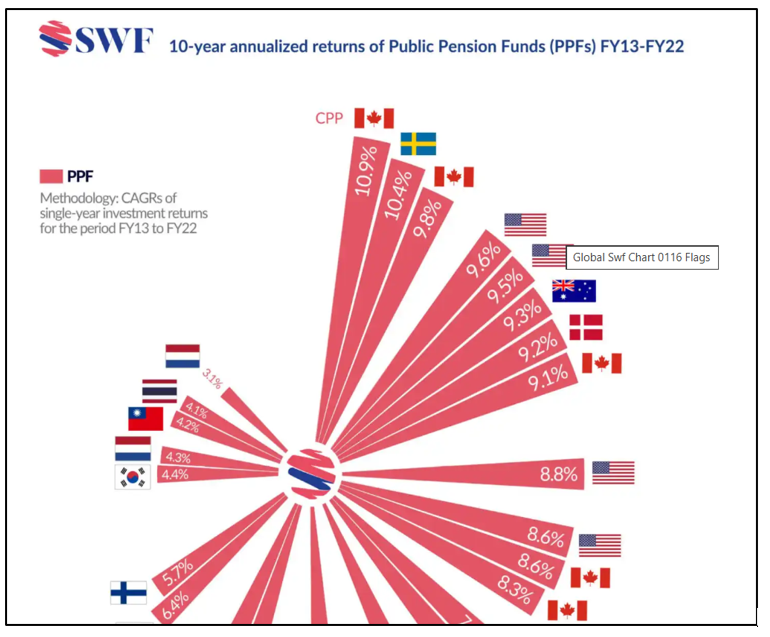
According to our Chief Actuary, only a 6% return is needed to fund all CPP pensions for the next 75 years.
The impact of this investment prowess on individual Canadians is monumental. Consider, for example, a 50-year-old in 2010 who had already contributed $100,000 to the CPP. With a 6% return, that $100,000 becomes $240,000 today. With CPP Investments’ 10% return, that $100,000 becomes $418,000 today, constituting a $220,000 surplus in just his personal CPP account.
Based on standard pension practice, he should now receive some of that $220,000 surplus, as I did as a professor at Ryerson University in 2000. Because the CRA ordered a surplus distribution, professors received as much as $20,000 each. Ryerson’s surplus was only 18% above target. The CPP’s $500 billion surplus is now 200% above target.
Even though the CPP holds roughly 10% of the lifetime earnings of most Canadians, our disgracefully deceptive Chief Actuary has full control. Our CRA and Auditor General have no jurisdiction. Even though pension experts recommend every pension fund have a Board of Governors composed of contributors and pensioners like you and me, the CPP has no such board. Such a board would have followed standard pension practice, distributed some of the CPP’s surplus and implemented the recommendations below, which probably 99% of Canadians would agree with.
Millions of our fellow Canadians are struggling financially.
A recent study found that 43% of Canadians are within $200 of insolvency.
Another study indicates “54% of Canadians currently have credit card debt, with 72% of Millennials (ages 29-44) carrying such debt.” The credit card interest rate is roughly 20%.
Food bank usage has doubled since 2019.
In Ontario, for example, mortgage delinquency rates are up by 135.2 per cent.
Canada’s ranking in the World Happiness Report plummeted from sixth place in life-satisfaction standings ten years ago to 25th place today, the worst ever. When only Canadians under 25 were tabulated, Canada fell to 71st. Notably, Finland is ranked number one. Finland’s financial industry earns 18% of all corporate profit compared to Canada’s 47%.
Young Canadians are struggling with mental health. Greenshield’s research below confirms this.
“TORONTO, Nov. 19, 2025 /CNW/ - A new survey from GreenShield, Canada's only national non-profit health care and insurance organization, conducted in partnership with Mental Health Research Canada (MHRC), reveals that over 80% of Canadian youth are overwhelmed by stress and anxiety about their future. Economic pressures – including job insecurity and the rising cost of living – are key drivers.”
Meanwhile, millionaire members or our financial industry are flourishing. The industry corners 47% of all corporate profit in Canada. For comparison, the US financial industry collects 25-30% of all corporate profit. And Europe’s average is 20-30%.
The industry is awash in cash. In December 2025, the Globe and Mail reported that Canada’s big banks distributed $27.3 billion in bonuses. An estimated 15,000 bank employees received $1.8 million each, on average, on top of their already substantial salaries.
With reasonable, no-risk legislation, the CPP’s surplus and potential could be used to substantially benefit 99% of Canadians while decreasing the incomes of Canada’s wealthiest 1%. Three multibillion-dollar benefits are available.
Benefit # 1 - Voluntary Contributions to CPP Investments
In 2011, when CPP Investments was only achieving mediocre returns, Finance Minister Jim Flaherty researched the idea of letting Canadians voluntarily invest with CPP Investments. Canada’s financial industry was aghast, claiming voluntarily investing with CPP Investments would be “too confusing” for Canadians.
Consider a 25-year-old Canadian who can afford to invest just $1,000 per year. Should it be with the financial industry, which, based on history, would likely give him a 5% return? Or should it be with CPP Investments which, based on history, would likely give give him a 10% return. The table below compares the two options.
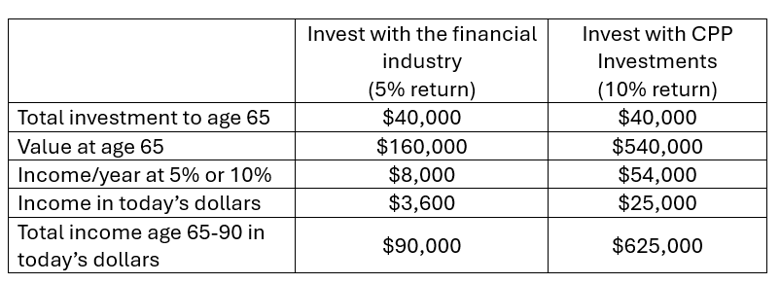
The table shows that, by investing $1,000 per year to age 65 with CPP Investments, instead of the financial industry, a 25-year-old will have $535,000 more in retirement, in today’s dollars, all tax-free using a TFSA.
The analysis presumes a 2% inflation rate per year.
With millions of Canadians investing with CPP Investments instead of Canada’s financial industry, the industry would eventually lose billions of dollars.
There would need to be a limit to how much any Canadian could invest. Otherwise, CPP Investments would be overwhelmed and unable to attain their impressive return on investment. For example, Canadians could be limited to investing $1,000 per year with CPP Investments.
Such a policy would lead to considerable improvements in mushrooming income inequality in Canada. Low-income Canadians would be enjoying a 10% return on as much as 100% of their investments while millionaires would only enjoy a 10% return on a small fraction of their investments.
Higher-income Canadians already enjoy considerable financial advantages. A 2017 statement in Parliament identified 64 advantageous federal tax measures: 59 were considered regressive, disproportionately benefiting higher-income Canadians, while only five were considered progressive. Allowing limited voluntary investments with CPP Investments would level this injustice while democratically giving every Canadian an equal opportunity to invest with CPP Investments.
Benefit #2 - Make the CPP a DC pension plan instead of a DB pension plan
Albert Einstein is credited with stating, “Compound interest is the eighth wonder of the world.” The following analysis demonstrates why.
The CPP is a Defined Benefit (DB) pension plan. Your pension is defined, regardless of how well CPP Investments invests your contributions. What is wrong with a CPP DB pension plan? For 10 years, you have not benefitted from the CPP’s $500 billion surplus, accumulated by CPP Investments, using your money. Based on standard pension practice, Canadians should now be receiving much of this giant surplus, which is roughly $23,000 per Canadian, on average. However, our Chief Actuary, for self-serving reasons as explained below, has ignored millions of financially struggling Canadians and denied the existence of this $500 billion surplus.
With the current CPP DB plan, you are receiving roughly a 4.75% return on your contributions while CPP Investments is achieving a 10% return.
In Canada’s private sector, almost all pension funds have migrated from a DB format to a DC format. With DC plans, the contributor receives the same return on investment as the investor achieves. With legislation, the CPP could easily become a Defined Contribution (DC) pension plan.
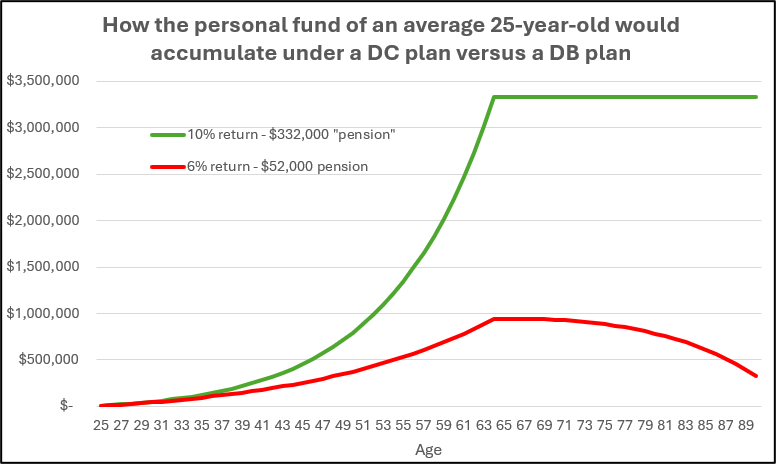
The following graph shows how the personal CPP fund of an average 25-year-old would accumulate under a DC plan versus a DB plan.
Notes:
In the DC plan example (green line), at age 65, the pensioner has elected to live off the investment income of $332,000 per year (10% return), leaving $3.32 million in his estate when he passes on at age 90, when, presuming a 2% inflation, $3.32 million is equivalent to $920,000 today. He would have much more flexibility when compare to a DB plan. Because of the DC format, the $3.32 million could be used at his discretion at any time for emergencies or an enhanced lifestyle.
Using a 2% inflation rate, 45.3% of all numbers above are the same value in today’s dollars. Thus, with a DC plan, the average 25-year-old Canadian would have a $150,000 CPP pension in today’s dollars. With a DB plan, his pension would be $23,500 in today’s dollars.
In both cases, the average pensioner will start his pension at age 65 and live to age 90, a reasonable estimate of Canadian’s average life expectancy in 65 years.
Consider a spousal survivor’s pension. In the DB plan, it will be 60% of $23,500 in today’s dollars - $14,100 per year, as long as the combined pensions are less than the CPP maximum. With a DC plan, survivors could continue to receive their partner’s $150,000 pension regardless of their own CPP pension.
This analysis presumes CPP Investments will continue to earn their 10% return of the last 15 years. There is near zero risk. Even in the unlikely event CPP Investments only averages a 4.75% return for 40 years, the pensioner would still receive the same pension from the CPP that he would receive with the current DB plan.
CPP Investments’ 10% return will likely continue because they have many investment advantages over the average investor. While most Canadians can only easily invest in public equity and fixed income, CPP Investments has hundreds of billions of dollars to invest in public equity, private equity, infrastructure, real estate and fixed income, worldwide. They have have 2,000 employees. most of whom are highly qualified. Many travel the world performing a detailed analysis on all investment possibilities. Then they recommend the ones that will be the most profitable. Because all CPP members pay their enormous salaries, we should have the right to directly benefit from their proven investment prowess.
For example, while Google claims The Pennsylvania Turnpike is the most expensive toll road in the world, 407-ETR in Ontario charges as much as ten times the toll rate of The Pennsylvania Turnpike. CPP Investments owns roughly half of 407-ETR. Upon hearing of 407-ETR’s profitability, several Canadians have stated, “I wish I could own some of that investment.” If the CPP converted to a DC format, they could.
If the CPP switched to a DC format, as all private sector pension plans have, Canadians would likely enjoy 6.4 times the CPP pension.
Why is this obvious solution not happening?
If the CPP switched to a DC format, the impact on Canada’s financial industry and actuarial profession would be significant.
If 25-year-old Canadians knew that their CPP contributions could probably provide them with a $150,000 CPP pension in today’s dollars, many would:
Stop investing the recommended 15% of their income towards retirement,
Stop contributing to other pension plans,
Stop purchasing life insurance because the CPP’s lucrative DC format would automatically give survivors roughly $1 million, at zero cost.
Demand the ability to voluntarily contribute to CPP Investments, as explained above.
The financial industry would then experience a multibillion-dollar reduction in profit from investment management fees collected from individuals, pension funds, and life insurance funds.
Additionally, actuaries receive an estimated two thirds of their income from monitoring pension funds and life insurance funds. Because most of these funds would gradually become unnecessary, employment for actuaries would plummet.
The above shows that the financial industry and actuarial profession certainly have the motivation to orchestrate this widespread cover-up. Do they have the resources? Just 1% of the financial industry’s annual profit is $2 billion, equivalent to 200 packets of a convincing $10 million each.
All politicians and numerous organizations with a benevolent mandate have been notified of this opportunity to help bring huge, deserved benefits to Canada’s less fortunate. All are are ignoring the opportunity. acting as if the financial industry has stated, for example,
“We will donate $10 million annually to your organization as long as you never mention the CPP’s surplus and potential.”
Moreover, with self-serving actuaries all agreeing to deny the CPP’s surplus, this cover-up has succeeded for over ten years. Who would dream of challenging the allegedly best mathematicians in the world?
The financial industry also virtually “owns” our entire mainstream media. To establish credibility with Canadians, our media accurately publishes every newsworthy story that will have no impact on the financial industry’s profit. However, all publications have vetoed this story because it would lead to a large loss in profit for the financial industry.
Even “our” CBC, which Canadians pay $50 each per year to fund, has betrayed us, stating, “This story is not newsworthy enough.”
We all have a personal CPP fund. If, for example, we are the same age, and you contributed double what I contributed every year, you will have double the pension.
Currently, the CPP tells Canadians virtually nothing about the status of their personal CPP fund. With a DC format, Canadians easily could be given an annual report of their contributions’ status. For example, they could be told annually,
January 31, 20??
Dear fellow Canadian,
As of December 31, 20??, you, and your employer on your behalf, had contributed $100,000 to the CPP. Thanks to CPP Investments’ 10% average return, your portfolio is now worth $200,000. If you keep contributing as you have, and CPP Investments continues with a likely 10% return, at age 65, you are on track to receive a $150,000 CPP pension in today’s dollars.
If this report indicated CPP Investments was repeatedly failing to reach its 10% target, then young Canadians could take heed and personally invest more towards retirement.
There are other benefits derived from a CPP DC format. In 2026, grants for seniors, excluding the CPP, totalled $89 billion per year. Roughly one of every six dollars spent by the government is now spent on benefits for seniors. These costs are increasing at a pace much higher than inflation. If most seniors eventually received a $150,000 CPP pension in 2026 dollars, seniors’ mushrooming benefit costs, in the form of the Guaranteed Income Supplement (GIS) and Old Age Security (OAS), would decline substantially.
What about seniors’ quality of life? Currently two million of six million seniors barely exist, struggling near the poverty line of roughly $25,000 per year. Changing the CPP from a DB to a DC format could reduce that number considerably. Eventually, with a CPP DC format, most of today’s two million low-income seniors, with a much larger pension, would live a longer life with improved quality.
(As the author collects his large professor’s pension, half paid for by all Canadians, if he tried to exist on $25,000 per year, his quality of life as a senior would decline from a 9 out of 10 to a 2 out of 10. Moreover, Statistics Canada shows that those in the top quintile of earnings live 6.7 years longer than those in the bottom quintile.)
What about younger Canadians? Financial anxiety among young Canadians is increasing rapidly. Impossible house prices, high rents, unemployment, AI, low-paying jobs and the threat of a retirement in poverty (magnified by the financial industry) are all contributing. If young Canadians were not only told a $150,000 CPP pension is likely, but they could have as much as 15% more income available today, their anxiety would decline substantially.
Many suspect our capitalist system is rigged to favour the wealthy. The above CPP reform would show them that our politicians place the best interests of 99% of Canadians ahead of the greedy interests of Canada’s greedy millionaires employed in the financial industry.
Canadians under 25 are now ranked 71st on The World Happiness Index. The prospect of a retirement with a $150,000 income and no need to invest today towards retirement would boost that dismal ranking substantially. Young Canadians could receive a message of:
Thanks to the new CPP Defined Contribution (DC) pension format, Canada has your back.
instead of the current message,
Politicians are intentionally ignoring a simple solution to youth unhappiness so that millionaires can become even wealthier.
Summary:
If the CPP converted to a DC format:
Young Canadians will be on track to receive a $150,000 CPP pension in 2026 dollars,
Young Canadians will have as much as 15% more income to spend today,
Anxiety among young Canadians will decline,
The number of seniors existing near the poverty line will plummet,
Soaring GIS and OAS costs will decline,
Mushrooming income inequality will decline.
This is not happening because:
The financial industry will lose billions of dollars in profit, per year,
Employment for actuaries will plummet.
Benefit # 3 - The CPP’s surplus - help for millions of Canadians who need immediate assistance
Please recall that 43% of Canadians are within $200 of insolvency, 54% have credit card debt, mortgage delinquency is soaring and the CPP has a 200% surplus. Standard pension practice recommends a surplus distribution when the surplus is a mere 25% above target. If our Chief Actuary followed standard pension practice and obeyed the principle of generational equity, he could, with no risk to future pensions, distribute some of the CPP’s $500 billion surplus.
For example, a no-risk $200 billion CPP surplus distribution would provide roughly $10,000, on average, to roughly 20 million Canadians.
Such a distribution would have have broad economic effects. Additional income in the hands of millions of households would increase spending throughout the economy, resulting in multibillion-dollar improvements in our economy in the areas of:
GDP growth,
productivity,
employment,
business profits,
Additionally, millions of low-income Canadians would enjoy relief from:
the threat of insolvency,
credit card interest charges of 20%,
income inequality,
poverty.
Finally, almost all social programs that help struggling Canadians increase our deficit. A $200 billion CPP surplus distribution would decrease our mushrooming deficit by an estimated $50 billion, through increased income tax, increased HST and reduced social programs.
Canada needs strategies to reduce our deficit. The increase in costs directed at defence are estimated at increasing our mounting deficit by $150 billion per year.
The Impact is Devastating on Millions of Struggling Canadians, Especially Seniors
Consider a scammer who has convinced a struggling, confused low-income senior to e-transfer him $1,000. Most Canadians would recommend considerable jail time for the thief.
Meanwhile, the failure to follow standard pension practice and distribute any pension fund surplus that is 25% above target means two million low-income seniors are not receiving a deserved $20 billion in total, $10,000 each, on average. This means the self-serving perpetrators of this CPP-surplus-denial scam are responsible for depriving low-income seniors of 20 million times the $1,000 that this example scammer stole. Where is their jail time?
Since 2016, one million low-income seniors have died, never receiving their deserved $10,000 from the CPP’s surplus. As studies show, many of these low-income seniors could have led a longer life with increased quality if they had received their deserved $10,000, a 40% increase in income.
Suppressing the news of the CPP’s $500 billion surplus is a national disgrace. On behalf of those 100,000 seniors who will die this year, and next year, and so on, one question needs to be asked. Are the greedy perpetrators of this cover-up arguably guilty of genocide?
Because our media is essentially owned by our financial industry, you are probably unaware of the CPP’s surplus. That means these perpetrators are literally getting away with murder. This blatant injustice against the less fortunate makes me, and I hope you, very angry.
Where are our politicians?
I have sent these details to all MPs several times. There has been virtually zero response. However, because Premier Smith received these details four years ago, this CPP injustice may result in Alberta separating from Canada. She has promised to give all Albertans as much as $10,000 each when she receives Alberta’s fair share of our $864 billion CPP fund. Because Ottawa is erecting roadblocks to prevent them receiving their deserved $10,000 either federally or provincially, many Albertans are now considering separation, as explained here.
If Canadians understood the impact of this cover-up, probably over 90% would vote for CPP reform in a referendum. In a country that Canadians think is reasonably democratic, the overwhelming evidence indicates a cover-up is in force that dwarfs the findings of the Charbonneau Commission. It found that hundreds of politicians, bureaucrats and consultants colluded to profit handsomely from inflating infrastructure costs in Quebec by 25%. Some politicians went to jail.
A pathetic defence from Finance Minister Freeland
On Sept. 11, 2024, Finance Minister Freeland defended her inaction on this crucial issue. In an email to me, she made the statements below, in italics. My response follows the italics:
“Consequently, the large build-up in the CPP Fund is necessary to pay for the promised level of benefits, in particular to the large baby boom generation.
Because actuaries have already accounted for “our large baby boom generation.”, the CPP’s surplus is still $500 billion.
“In addition, it is important to maintain a certain buffer in the CPP Fund to protect against sudden and unexpected negative shocks to the global economy, such as a collapse of oil prices, a financial crisis or the impact of a global pandemic on the world economy.”
The standard pension fund surplus guideline needed “to protect against sudden and unexpected negative shocks to the global economy” is a 25% surplus. The CPP now has a 200% surplus.
Her overzealous caution is absurd. It is akin to a multi-millionaire saying,
“I am only spending $5 for lunch at McDonald’s because my multimillion-dollar portfolio could plummet in value tomorrow. Even though my offspring are visiting food banks and many may soon die, I will not help them with my huge personal surplus today.”
Ms. Freeland is the author of PLUTOCRATS - The Rise of the New Global Super-Rich and the Fall of Everyone Else. The book’s central argument is that our capitalist system is rigged to favour the super-rich. Even though our Finance Minister has written a book about the power of Canada’s super-rich, she has done nothing to combat it, even when presented with the details above. Shortly after sending me this email, she resigned from politics, probably unable to stomach her hypocrisy and the futility of trying to combat this cover-up. The power of Canada’s financial industry must be enormous.
Duff Conacher of Democracywatch.ca emphasizes the significant financial impact of corporate cash, stating,
"Corporations spend $25 billion annually on their lobbying and promotion efforts."
Women, Income Inequality, and the Fight for Financial Fairness in Canada
Women are disproportionately affected by the outcomes of systems that remain largely shaped by male-dominated leadership.
Approximately two-thirds of low-income seniors are women. During their working years, women earn, on average, about 87 cents for every dollar earned by men, resulting in lower lifetime savings and reduced retirement security. When families separate, women most often assume primary responsibility for childcare, frequently bearing the financial strain that follows. In some cases, support payments are inconsistent or absent, leaving mothers to pursue costly legal remedies—or to manage alone.
At the same time, women remain underrepresented in many of the institutions that influence financial outcomes. Only about 25–30% of senior roles in the financial industry are held by women. In the actuarial profession, women represent roughly one-third of practitioners, with fewer at senior levels. In media leadership, women also account for only about one-quarter to one-third of decision-making positions.
The result is a gap not only in income, but in influence—particularly in areas that shape financial policy, retirement systems, and public awareness.
If you are a woman, your voice is essential in addressing these issues and advocating for fairer outcomes. And if you believe in equity and accountability, I encourage you—regardless of gender—to support efforts that seek meaningful change.
The only senior Canadian politician willing to combat this cover-up on behalf of her constituents is a woman, Premier Smith.
A summary of the pros and cons of these recommendations
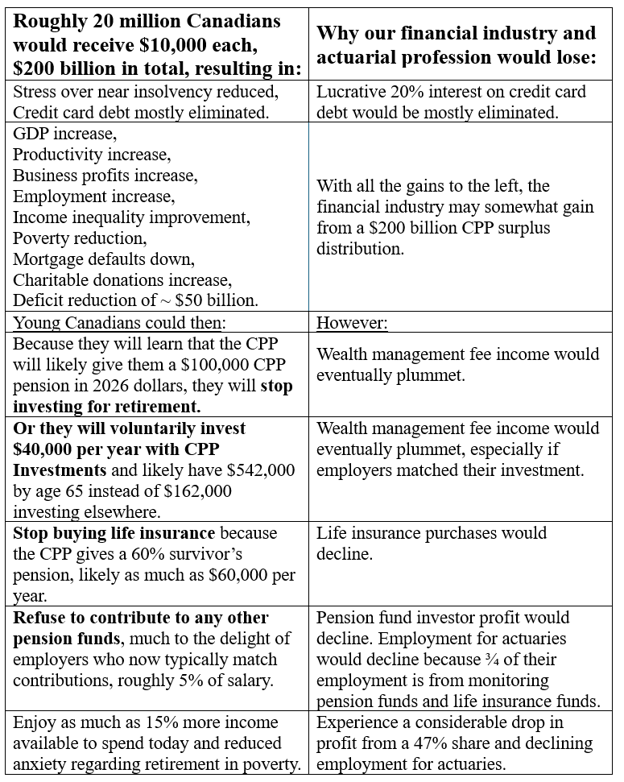
The benefits summarized in the left column would bring a huge improvement to the lives of millions of struggling Canadians and Canada’s anemic economy. The right column indicates members of Canada’s financial industry and actuarial profession would experience a considerable decline in their exorbitant incomes with CPP reform implemented.
For most Canadians, job security has been tenuous. Tariffs, robots, ATMs, online shopping, self-checkout, computer-generated help lines and much more have all led to job loss for millions of low-income Canadians. And AI is forecast to replace millions more jobs. For example, graduates of IT programs are not being hired because AI can write a computer program in ten seconds that would take a programmer one week.
Why do our politicians idly watch as millions of their fellow Canadians face unemployment, general upheaval, and income reduction while they suspiciously protect the millionaires in the financial industry and actuarial profession?
How Canada Could Rise in the Happiness Rankings
In The World Happiness Report, while Canada has plummeted from a ranking of 25 from 6, Finland consistently ranks first. Finland’s society is built on:
very low levels of corruption,
high trust in government and public institutions,
a strong social safety net,
low income inequality.
These factors create a sense of stability and security that underpins overall well-being.
Younger Canadians face a wide range of challenges: unemployment, high housing costs, rising rents, growing income inequality, climate concerns, and increasing financial stress.
Demographic trends also highlight the economic challenges facing younger generations. Since the mid-1970s, Canada’s fertility rate has declined significantly—from about 2.1 children per woman, the level needed to sustain population growth, to roughly 1.25 today. One reason Canada’s birth rate has declined relates to affordability.
Recall that Canada’s under-25 population is so unhappy that, in 2026, Canada is ranked 71st in The World Happiness Report for that age group. With 70 nations ranking above us, who must be near us or below us in the ranking? Likely, only nations rife with poverty, suffering, low income and half our longevity.
Imagine how much happier our younger Canadians would be if our politicians told them the truth:
you can expect a likely $150,000 CPP pension in 2026 dollars,
you don’t need to invest anything today towards retirement,
you don’t need to buy life insurance,
you can make triple the money by investing voluntarily with CPP Investments instead of the financial industry,
you don’t need to contribute to any other pension funds.
Currently, younger Canadians likely feel that the system is failing them and older Canadians are thriving at their expense. And there is nothing they can do about it.
To be fair, a big reason for youth unhappiness is unemployment. However, if the CPP followed standard pension practice and released a deserved $200 billion surplus payment, roughly $10,000 to each of 20 million Canadians, the resultant spending would create thousands of jobs. And if young Canadians were told they no longer needed to invest towards retirement, their extra income available today would also stimulate spending and also create many thousands of jobs.
If our legislators were to adopt the CPP legislation described above, Canada could significantly improve its standing in The World Happiness Report rankings. More importantly, it would enhance the day-to-day lives of millions of Canadians, now struggling.
Is there nothing young Canadians can do about it? What about Generation Squeeze, probably Canada’s largest organization dedicated to helping young Canadians. It allegedly:
“cuts through political noise to hold governments accountable to young and future generations. We're a breath of fresh credibility and academic rigour in an era of misinformation.”
Regarding funding, their website states:
“Gen Squeeze research and policy judgments are made independently, and not on the basis of donor or funder support. These judgements are guided by the best available evidence, and the expertise of our network of research alliances, partners and volunteers.”
Professor Paul Kershaw of UBC is the leader. I have repeatedly presented him with the above details. He has provided absolutely zero defence of his inaction regarding the CPP’s surplus and potential. If he used his considerable pipeline to educate thousands of young Canadians regarding the CPP’s surplus and potential, it might generate a groundswell of protest. Thousands of young Canadians might protest so strongly that our government and media would be forced to pay attention. Such a protest could even “go viral”.
However, Professor Kershaw acts like leaders of numerous other allegedly benevolent organizations across Canada. Generation Squeeze is acting as if it has received a considerable annual donation from the financial industry with one condition - Never mention the CPP’s surplus and potential. If Professor Kershaw acted appropriately, we could likely bring Canada’s under-25 population from a disgusting ranking of 71 on The World happiness Report back to a reasonable ranking of 6, what Canada, overall, was ranked in 2016.
Professor Kershaw belongs high on The Reverse Order of Canada List. First, he masqueraded as the prime watchdog and advocate for Canada’s struggling youth, thereby making millions of young Canadians conclude that, with all those resources and funding, “He has probably uncovered and advocated against any and all injustice against Canada’s young.”
Then, when given overwhelming evidence of a cover-up that is depriving millions of young Canadians of benefits in the hundreds of billions of dollars, he has remained disgracefully silent. It should be noted that, if my claims are incorrect, I could face a lawsuit.
A pathetic defence from Finance Minister Freeland
On Sept. 11, 2024, Finance Minister Freeland defended her inaction on this crucial issue. In an email to me, she stated, with my response below in italics:
“Consequently, the large build-up in the CPP Fund is necessary to pay for the promised level of benefits, in particular to the large baby boom generation.
(Actuaries have already planned for “our large baby boom generation.)
In addition, it is important to maintain a certain buffer in the CPP Fund to protect against sudden and unexpected negative shocks to the global economy, such as a collapse of oil prices, a financial crisis or the impact of a global pandemic on the world economy.”
(The standard pension fund surplus guideline “to protect against sudden and unexpected negative shocks to the global economy” is a 25% surplus. The CPP now has a 200% surplus.)
Her overzealous caution is absurd. It is akin to a multi-millionaire saying,
“I am only spending $5 for lunch at McDonald’s because my multimillion-dollar portfolio could plummet in value tomorrow. Even though my offspring are visiting food banks and many may soon die, I will not help them today.”
Ms. Freeland is the author of PLUTOCRATS. The book’s central argument is that our capitalist system has been rigged to favour the super-rich. Even though our Finance Minister has written a book about the power of Canada’s super-rich, she has done nothing to combat it, even when presented with the details above. Shortly after sending me this email, she resigned from politics, probably unable to stomach her hypocrisy and the futility of trying to combat this cover-up. The power of Canada’s financial industry must be enormous.
Why aren’t these benefits reaching millions of struggling Canadians?
Three powerful, influential industries or professions would lose billions of dollars and lucrative employment if the news of the CPP’s surplus becomes known. The evidence, collected over ten years, that they have orchestrated a massive cover-up, can be found by clicking below.
If the recommendations below were implemented, millions of floundering Canadians would enjoy a considerable improvement in their quality of life. However, the overwhelming evidence indicates the selfish interests of Canada’s wealthiest 1% have been favoured over the interests of the other 99%. On this crucial issue, democracy, freedom of press and actuarial science have all been replaced with a deception that is having a profound negative impact on millions of Canadians and our sputtering economy.
The issue goes far beyond pensions. It affects:
the disposable income available to younger Canadians,
the financial security of seniors,
the strength of Canada’s economy.
Albertans’ desire to separate from Canada.
My interest in the CPP is also partly personal. The MacNaughton family has long been connected to the history of the Canada Pension Plan.
Because CPP Investments has been the best pension fund investor in the world for 15 years, our CPP fund now has a $500 billion surplus as shown here. Fifteen years ago, our Chief Actuary specified a 6% return is necessary for fund stability, resulting in a $366 fund value today. Because CPP Investments has averaged a 10% return for 15 years, our comparable CPP Fund’s value is $725 billion. With an ongoing 10% return, which is likely, the CPP fund only needs roughly $245 billion in the fund to meet all pension commitments. This means our CPP fund now has a $500 billion surplus, 200% above what is needed.
How likely is an ongoing 10% return? Because CPP Investments:
has roughly 2,000 employees with an average income of $575,000 each, with most holding a MBA degree,
has hundreds of employees searching worldwide for profitable private equity investments,
has the resources to purchase a majority share in most small to medium companies, then controlling management using proven expertise,
can also invest in profitable real estate and infrastructure,
can also invest in public equities and fixed income, essentially the only investment options for the average Canadian, aside from a home…
…CPP Investments will likely continue achieving their outstanding 10% return of the last 15 years.
My father’s cousin, Charles MacNaughton, served as Treasurer of Ontario from 1958 to 1962. Representing Canada’s largest province at the time, he was substantially involved in the discussions that shaped the framework of the CPP in its early years.
His son, John MacNaughton—my second cousin—later played a major role in transforming how the CPP invests its funds. After the landmark pension reforms of 1997, John became the first President and CEO of the Canada Pension Plan Investment Board, now known as CPP Investments. Before those reforms, CPP contributions were invested mainly in fixed-income securities. Under his leadership, CPP Investments began investing globally in public equity, private equity, infrastructure, real estate, and more. Over the past fifteen years, this strategy has produced the strongest investment results of all the pension funds in the world.
The purpose of this website is simple: to present the evidence clearly and allow Canadians to judge for themselves.
A big discrepancy in income
With CPP reform, 99% of Canadians would win but Canada’s financial industry would lose
Canada’s financial industry corners 47% of all corporate profit in Canada but only contributes 7.4% to our GDP. For comparison, the US financial industry only collects 25-30% of all corporate profit. Europe’s average is 20-30%.
The Canadian financial industry is awash in cash. In December 2025, the Globe and Mail reported that Canada’s big banks distributed $27.3 billion in bonuses. An estimated 15,000 bank employees received $1.8 million each on top of their salaries.
Bank profits, and hence bonuses, are continuing to mushroom. On August 7, 2026, The Globe and Mail wrote that “several banks posted consecutive quarters of double-digit earnings growth.”
Meanwhile, millions of Canadians are struggling.
A recent study found that 43% of Canadians are within $200 of insolvency. On March 9, 2026, The Globe and Mail wrote that “Household debt in Canada as a percentage of GDP is 103 per cent, second-highest among 34 OECD countries.”
Another study indicates “54% of Canadians currently have credit card debt, with 72% of Millennials (ages 29-44) carrying such debt.” The credit card interest rate is roughly 20%.
Food bank usage has doubled since 2019.
In Ontario, for example, mortgage delinquency rates are up by 135.2 per cent.
Canada’s ranking in the World Happiness Report plummeted from sixth place in life-satisfaction standings ten years ago to 25th place today, the worst ever. When only Canadians under 25 were counted, Canada fell to 71st. Notably, Finland is ranked number one. Finland’s financial industry earns 18% of all corporate profit compared to Canada’s 47%.
Young Canadians are struggling with mental health. Greenshield research confirms this.
“TORONTO, Nov. 19, 2025 /CNW/ - A new survey from GreenShield, Canada's only national non-profit health care and insurance organization, conducted in partnership with Mental Health Research Canada (MHRC), reveals that over 80% of Canadian youth are overwhelmed by stress and anxiety about their future. Economic pressures – including job insecurity and the rising cost of living – are key drivers.”