Introduction
Because CPP Investments has been the best pension fund investor in the world for 15 years, our CPP fund now has a surplus of roughly $500 billion. This represents a $23,000 surplus, on average for each of the 22 million CPP contributors and pensioners. This includes all adult Canadians outside Quebec, which has its own QPP.
The CPP’s surplus and potential could bring huge benefits to 99% of Canadians. However, with appropriate legislation, the CPP could lead to huge losses for Canada’s financial industry, which now greedily corners 47% of all corporate profit. Such legislation would also lead to employment for actuaries falling drastically.
Here are the benefits:
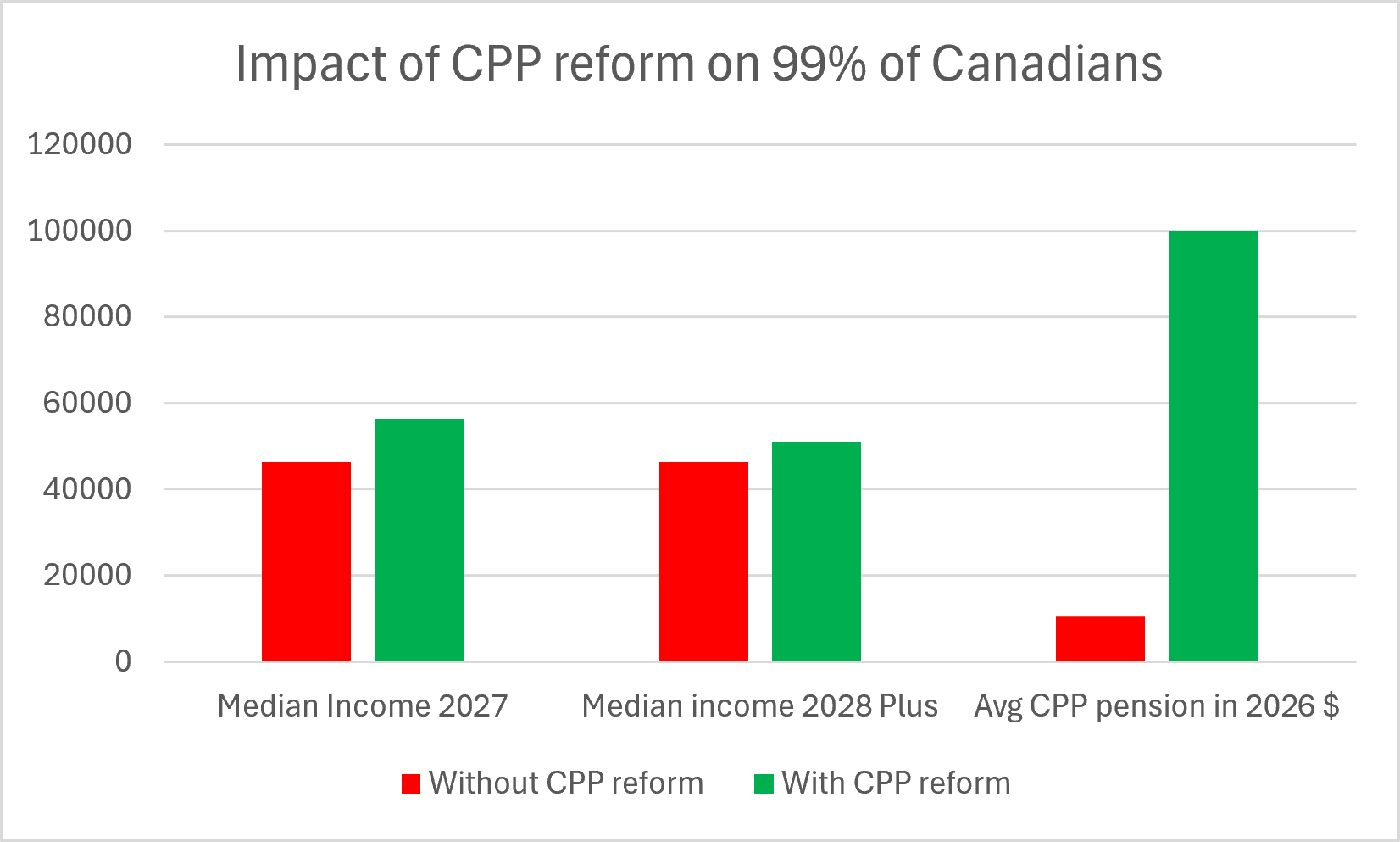
A) Median income of all Canadians.
B) The CPP’s $500 billion surplus is 200% above target. When a pension fund has a mere 25% surplus, standard pension practice demands a surplus distribution. A no-risk $200 billion CPP surplus distribution would give all Canadians $10,000 each, on average. Moreover, a $200 billion surplus distribution considerably improve Canada’s main areas of concern - GDP, productivity, employment, business profits, poverty, income inequality and deficit.
C) Median income of all Canadians.
D) Because CPP Investments has many investment advantages over average investors, they have averaged a 10% investment return for 15 years. With an ongoing 10% return, which is likely, average 25-year-olds will deserve a $100,000 CPP pension in 2026 dollars. Knowing this, they would no longer invest towards retirement, contribute to other pension funds, or buy life insurance (because the CPP gives a surviving spouse 60% of her partner’s pension).
E) Current average CPP pension - $10,500 per year.
F) Deserved CPP pension for a 25-year-old if CPP Investments continues averaging a 10% return.
Why is this beneficial legislation not even discussed?
In 2011, when CPP Investments was averaging a mediocre 6% investment return, Finance Minister Flaherty suggested Canadians should be allowed to invest with CPP Investments. If so, CPP Investments’ likely 10% return would give Canadians seven times the profit over 40 years, when compared to the financial industry’s typical 5% return. Tens of billions of investment dollars would then leave the financial industry and join CPP Investments, resulting in substantial losses for the financial industry.
Moreover, because CPP Investments will likely be able to give a 25-year-old Canadian a $100,000 CPP pension, in 2026 dollars, young Canadians will:
Stop investing the recommended 15% of their income towards retirement.
Stop contributing to other pension funds.
Stop purchasing life insurance because of the CPP’s survivor benefits.
Demand voluntary contributions to CPP Investments.
The resultant lost profit for Canada’s investment industry, pension fund industry, and life insurance industry would be enormous. Additionally, because more than half of employment for actuaries is monitoring pension funds and life insurance funds, employment for actuaries would plummet.
Based on my ten years of research, overwhelming evidence indicates our financial industry has colluded with the actuarial profession to:
Convince all politicians, except Premier Smith, that CPP reform would not be beneficial for Canadians, overall. Vacuous arguments by convincing lobbyists and probably cash, under-the-radar, were involved.
Control the entire Canadian mainstream media using generous “donations”. This explains why the highly newsworthy story of the CPP’s surplus and potential has never been mentioned.
Control numerous benevolent organizations using “donations” with one condition - “Never mention the CPP’s surplus.”